
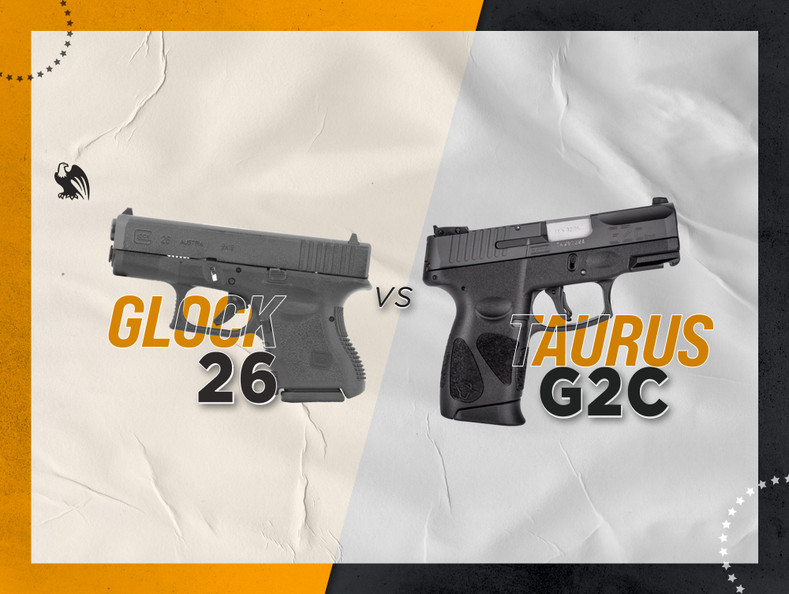
Taurus G2C vs Glock 26: The Ultimate Concealed Carry Showdown – Terry Gun Store’s Expert Analysis
In This Article
- Understanding the Glock 26: A Concealed Carry Legend
- Exploring the Taurus G2C: Budget-Friendly Excellence
- Comprehensive Specifications Comparison
- Size, Weight & Magazine Capacity Analysis
- Frame Construction, Slide Design & Barrel Quality
- Sight Systems & Optics Compatibility
- Control Features: Triggers & Safety Mechanisms
- Reliability & Performance in Real-World Conditions
- Maintenance & Aftermarket Support
- Price-to-Value Ratio Analysis
- Making Your Final Decision: Which Pistol Suits Your Needs?
Introduction: Choosing Your Ideal Concealed Carry Companion
When you’re in the market for a dependable concealed carry pistol, the decision-making process can feel overwhelming with countless options flooding the marketplace. Two firearms that consistently rise to the top of consideration lists are the legendary Glock 26 and the increasingly popular Taurus G2C. At Terry Gun Store, we’ve witnessed countless customers deliberate between these two exceptional handguns, and we understand the importance of making an informed decision when your personal safety is on the line.
The debate between the Taurus G2C versus the Glock 26 isn’t simply about declaring one pistol categorically superior to the other. Rather, it’s about understanding the nuanced differences, recognizing the distinct advantages each firearm offers, and ultimately determining which platform aligns most effectively with your specific requirements, preferences, and concealed carry philosophy.
Both of these compact powerhouses deliver remarkable functionality in surprisingly small packages. They share numerous similarities in overall dimensions and construction methodology, yet they diverge significantly in several critical areas that may substantially influence your purchasing decision. The Taurus G2C distinguishes itself with features like an integrated accessory rail for tactical lights or lasers and a manual thumb safety for those who prefer an additional layer of security. Conversely, the Glock 26 showcases modular backstrap technology for customized grip ergonomics and incorporates Glock’s renowned Safe Action trigger system, which has earned the trust of law enforcement agencies and civilian carriers worldwide.
Throughout this comprehensive analysis from Terry Gun Store, we’ll meticulously examine every aspect of these two formidable concealed carry options. We’ll dissect their specifications, evaluate their safety features, compare their sight systems, analyze their size-to-capacity ratios, and explore numerous other factors that should inform your decision. By the conclusion of this detailed comparison, you’ll possess the knowledge necessary to confidently select the pistol that best serves your concealed carry needs.
Understanding the Glock 26: A Concealed Carry Legend
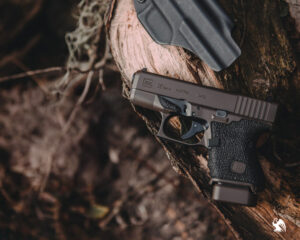
![Glock 26 Gen4 9mm pistol with textured grip resting on a log beside a black Kydex holster in an outdoor woodland setting.]
The Glock 26, affectionately nicknamed the “Baby Glock” by enthusiasts, represents Glock’s purpose-built answer to the concealed carry market’s demand for maximum firepower in a minimal footprint. This subcompact powerhouse has earned its reputation through decades of proven performance in the most demanding circumstances imaginable.
Taurus G2C vs Glock 26: The Ultimate Concealed Carry Showdown
Design Philosophy and Engineering Excellence
Chambered in the universally popular 9mm Luger cartridge, the Glock 26 delivers serious stopping power without the punishing recoil characteristics associated with more compact firearms chambered in larger calibers. The standard configuration ships with a 10-round magazine capacity, which might initially seem modest compared to full-size service pistols. However, this is where Glock’s brilliant engineering truly shines; the G26 maintains complete compatibility with the higher-capacity magazines designed for its larger siblings, the Glock 17 and Glock 19. This means you can seamlessly utilize 15-round, 17-round, or even 33-round extended magazines, transforming your subcompact carry gun into a formidable defensive tool with firepower rivaling full-size service pistols.
Ideal Applications and Versatility
The compact dimensions of the Glock 26 make it an outstanding choice for multiple carry scenarios. Many experienced shooters at Terry Gun Store employ the G26 as their primary concealed carry weapon during warmer months when lighter clothing makes concealment more challenging. Others utilize it as a highly capable backup gun, providing a reliable secondary option that shares ammunition and magazine compatibility with their primary Glock pistol. This interoperability cannot be overstated. In critical situations, the ability to share magazines between your primary and backup firearms can prove invaluable.
The Safe Action Trigger System
One of the Glock 26’s most distinctive features is its Safe Action trigger system, which represents Glock’s innovative approach to firearm safety. Rather than incorporating external manual safeties that require conscious manipulation, the Safe Action system integrates three independent mechanical safeties directly into the fire control mechanism itself. These safeties, the trigger safety, firing pin safety, and drop safety, work in concert to prevent accidental discharge while maintaining the pistol’s readiness for immediate defensive use. The trigger safety, that small lever visible within the trigger face, must be deliberately depressed for the trigger to move rearward. The firing pin safety mechanically blocks the firing pin’s forward movement until the trigger is fully pressed. The drop safety prevents firing pin movement if the pistol is dropped or subjected to impact. This trilogy of passive safety mechanisms engages automatically when the trigger is released, requiring no conscious thought or manipulation from the shooter.
Physical Specifications and Carry Characteristics
Tipping the scales at merely 21.52 ounces when unloaded, the Glock 26 achieves an impressive balance between substantial feel and lightweight portability. Its overall length measures 6.5 inches, with a width of just 1.26 inches and a height of 4.17 inches, making it exceptionally concealable in various carry positions. The 3.43-inch barrel provides adequate sight radius for accurate shooting while maintaining the compact profile essential for concealed carry applications.
The polymer frame construction contributes significantly to the pistol’s light weight while providing exceptional durability and resistance to environmental factors like moisture, chemicals, and temperature extremes. The Tenifer-coated steel slide offers superior wear resistance and corrosion protection, ensuring your investment maintains its functionality and appearance through years of regular carry and use.
At Terry Gun Store, we stock an extensive selection of Glock 26 models and can help you explore the various generations and configurations available. Additionally, we offer a comprehensive range of IWB (inside-the-waistband), OWB (outside-the-waistband), and pocket carry holsters specifically designed for the Glock 26, ensuring you can carry your pistol comfortably and securely in whatever manner best suits your lifestyle and wardrobe.
Exploring the Taurus G2C: Budget-Friendly Excellence
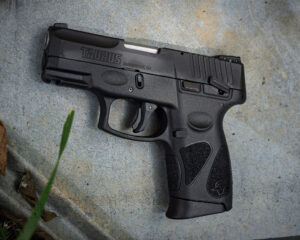
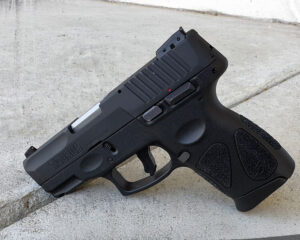
Taurus G2C 9mm compact pistol with black polymer frame and textured grip, resting on concrete with safety and slide stop levers visible.]
The Taurus G2C has emerged as a genuine phenomenon in the concealed carry marketplace, challenging long-held assumptions about the relationship between price and quality. This compact semi-automatic pistol has cultivated an enthusiastic following among firearms enthusiasts who recognize exceptional value when they encounter it.
Taurus G2C vs Glock 26: The Ultimate Concealed Carry Showdown
Reputation for Dependability and Affordability
What truly distinguishes the Taurus G2C in today’s competitive market is its remarkable ability to deliver reliable performance at a price point that makes firearm ownership accessible to a broader demographic. At Terry Gun Store, we’ve witnessed countless first-time gun buyers and experienced shooters alike discover that the G2C punches well above its weight class, offering features and reliability that would typically command a significantly higher price tag.
Construction Quality and Materials
The G2C’s construction methodology reflects thoughtful engineering and quality materials selection. The polymer frame provides the lightweight durability that modern shooters demand, while the stainless steel barrel ensures longevity and consistent accuracy through thousands of rounds. The aluminum alloy slide strikes an excellent balance between weight reduction and structural integrity, contributing to the pistol’s manageable recoil characteristics and overall handling qualities.
One feature that immediately catches the eye is the aggressively textured grip surface. This isn’t merely aesthetic; the texturing provides genuine functional benefit by ensuring positive purchase even when your hands are wet, sweaty, or gloved. In defensive situations where adrenaline and stress can compromise fine motor skills, this enhanced grip texture can make a meaningful difference in weapon retention and control.
Sight System and Target Acquisition
The low-profile sight configuration on the G2C facilitates rapid target acquisition while minimizing the risk of snagging on clothing during the draw stroke. These sights are designed with practical defensive shooting in mind, recognizing that concealed carry encounters typically occur at close distances where speed matters more than precision long-range accuracy. The sight picture is intuitive and quick to acquire, allowing shooters to get on target efficiently in high-stress scenarios.
Comprehensive Safety Features
Safety represents a paramount concern for any defensive firearm, and the Taurus G2C addresses this through multiple redundant safety mechanisms. The loaded chamber indicator provides immediate visual and tactile confirmation of the pistol’s condition—a feature particularly valuable for newer shooters who are still developing their firearm handling habits. The manual thumb safety offers an additional layer of security for those who prefer the peace of mind that comes with a positive mechanical safety that must be deliberately disengaged before firing. Finally, the trigger safety prevents rearward trigger movement unless deliberately pressed, reducing the likelihood of accidental discharge from inadvertent trigger contact.
This multi-layered approach to safety makes the G2C particularly appealing to shooters who are transitioning from other firearm platforms or who simply prefer having multiple safety mechanisms at their disposal.
Physical Dimensions and Capacity
Despite its compact dimensions, measuring just 5.1 inches in height, 1.2 inches in width, and 6.3 inches in overall length, the Taurus G2C manages to accommodate an impressive 12-round magazine capacity. This represents a significant advantage over many competing pistols in this size category, providing two additional rounds compared to the Glock 26’s standard magazine. The 3.2-inch barrel length provides adequate velocity for defensive ammunition while maintaining the compact profile necessary for comfortable concealed carry.
Weighing in at 22 ounces unloaded, the G2C is remarkably similar to the Glock 26 in terms of carry weight, meaning neither pistol offers a significant advantage in this regard. Both are light enough for all-day carry comfort yet substantial enough to manage recoil effectively.
Accessory Rail Integration
One feature where the Taurus G2C clearly distinguishes itself from the Glock 26 is the inclusion of a 1-inch tactical accessory rail integrated into the frame’s dust cover. This rail allows for the mounting of compact weapon lights or laser aiming devices, significantly enhancing the pistol’s versatility. For home defense applications or low-light carry scenarios, the ability to mount a light source directly to your pistol can prove invaluable. Many defensive shooting experts emphasize the importance of positive target identification before engaging, and a weapon-mounted light facilitates this critical step.
At Terry Gun Store, we maintain an extensive inventory of Taurus G2C models and can guide you through the various options available. We also stock a comprehensive selection of IWB, OWB, and pocket carry holsters specifically engineered for the G2C’s dimensions and features, including holsters that accommodate weapon-mounted lights. Our knowledgeable staff can help you select the optimal holster configuration for your specific carry preferences and requirements.
Comprehensive Specifications Comparison
Understanding the technical specifications of these two pistols provides essential context for making an informed purchasing decision. While raw numbers don’t tell the complete story, they offer valuable insights into each firearm’s capabilities and characteristics.
| Specification | Glock 26 | Taurus G2C |
|---|---|---|
| Caliber | 9mm Luger | 9mm Luger |
| Classification | Subcompact | Compact |
| Overall Height | 4.17 inches | 5.10 inches |
| Overall Length | 6.50 inches | 6.30 inches |
| Barrel Length | 3.43 inches | 3.20 inches |
| Width | 1.26 inches | 1.20 inches |
| Unloaded Weight | 21.52 ounces | 22 ounces |
| Standard Capacity | 10+1 rounds | 12+1 rounds |
| Manufacturer’s Suggested Retail Price | Approximately $600 | Approximately $304 |
Analyzing the Numbers
Several interesting observations emerge from this specification comparison. Both pistols are chambered in 9mm Luger, which has become the dominant defensive handgun cartridge due to its excellent balance of stopping power, manageable recoil, and ammunition availability. This caliber commonality means that ammunition selection, training costs, and ballistic performance will be essentially identical between the two platforms.
The classification difference, subcompact versus compact, reflects subtle distinctions in overall dimensions, though in practical terms, both pistols occupy similar positions in the concealed carry market. The Glock 26’s slightly longer overall length (6.50 inches versus 6.30 inches) is offset by its shorter height (4.17 inches versus 5.10 inches), resulting in different but comparable concealment profiles. The Taurus G2C’s reduced width (1.20 inches versus 1.26 inches) may provide a marginal advantage for appendix carry or other positions where thickness significantly impacts concealment.
The weight difference between these pistols is negligible; less than half an ounce separates them when unloaded. This similarity means that neither firearm offers a meaningful advantage in terms of carry comfort or weight-related fatigue during extended carry periods.
Perhaps the most significant specification difference lies in standard magazine capacity. The Taurus G2C’s 12+1 capacity provides two additional rounds compared to the Glock 26’s 10+1 configuration. While some might dismiss this as a minor difference, those two extra rounds could prove critical in a defensive encounter. That said, the Glock 26’s compatibility with higher-capacity Glock 17 and 19 magazines effectively negates this advantage if you’re willing to carry spare magazines or utilize extended magazines.
The price differential represents the most dramatic specification difference. With an MSRP approximately half that of the Glock 26, the Taurus G2C delivers remarkable value for budget-conscious buyers. This substantial price advantage allows shooters to invest the savings in ammunition for training, quality holsters, or other essential accessories, all of which contribute meaningfully to defensive preparedness.
Size, Weight & Magazine Capacity Analysis
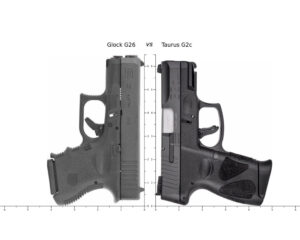
Side-by-side comparison of the Glock 26 and the Taurus G2C, set on a grid-style background to provide measurements of size.
When evaluating concealed carry pistols, the relationship between size, weight, and capacity represents a critical consideration. These factors directly impact concealability, comfort during extended carry, and defensive capability.
Taurus G2C vs Glock 26: The Ultimate Concealed Carry Showdown
Dimensional Comparison and Concealment Implications
The dimensional similarities between the Glock 26 and Taurus G2C are striking, yet the subtle differences merit careful consideration. The Glock 26’s reduced height (4.17 inches versus 5.10 inches) makes it slightly more concealable when carried in positions where grip length affects printing, particularly appendix carry or pocket carry. A shorter grip is less likely to print through clothing or become visible when bending, reaching, or moving dynamically.
Conversely, the Taurus G2C’s marginally shorter overall length (6.30 inches versus 6.50 inches) and reduced width (1.20 inches versus 1.26 inches) may provide advantages in other carry positions. The slimmer profile can make a noticeable difference when carrying inside the waistband, where every fraction of an inch contributes to overall comfort and concealment.
In practical terms, both pistols conceal effectively in proper holsters with appropriate clothing choices. The differences, while measurable, are subtle enough that most carriers won’t experience dramatically different concealment characteristics between the two platforms. Your body type, wardrobe preferences, and chosen carry position will likely influence concealment success more significantly than these minor dimensional variations.
Weight Considerations for All-Day Carry
The near-identical weight between these pistols (21.52 ounces versus 22 ounces unloaded) means that neither offers a meaningful advantage in terms of carry comfort. Both are light enough to carry comfortably throughout an entire day without causing significant fatigue or discomfort, yet substantial enough to provide adequate mass for managing recoil during rapid fire strings.
It’s worth noting that these weights represent unloaded configurations. When you factor in a loaded magazine, the weight increases by several ounces depending on magazine capacity and ammunition type. A fully loaded Glock 26 with a 10-round magazine weighs approximately 26 ounces, while a fully loaded Taurus G2C with its 12-round magazine tips the scales at roughly 28 ounces. This difference remains minimal and unlikely to significantly impact carry comfort for most individuals.
Magazine Capacity and Defensive Capability
The magazine capacity comparison reveals one of the more significant practical differences between these pistols. The Taurus G2C’s standard 12+1 capacity provides 13 total rounds—two more than the Glock 26’s 10+1 configuration. In defensive shooting scenarios, where shot placement under stress can be challenging, and multiple threats may be present, those additional rounds provide meaningful extra capability.
However, this advantage must be contextualized within the broader ecosystem of available magazines. The Glock 26’s compatibility with Glock 17 and 19 magazines means you can easily carry a spare 15-round or 17-round magazine, dramatically increasing your total ammunition capacity. Some shooters even utilize these higher-capacity magazines as their primary magazine in the pistol, accepting the extended grip length in exchange for substantially increased capacity. With a 17-round magazine inserted, the Glock 26 offers 17+1 capacity, significantly exceeding the Taurus G2C’s standard configuration.
Extended magazines are also available for the Taurus G2C, though the aftermarket support and variety of options don’t quite match what’s available for Glock pistols. This reflects Glock’s longer market presence and larger user base rather than any inherent limitation of the Taurus platform.
The Budget Factor: Price-to-Performance Ratio
While not strictly a size or capacity consideration, the dramatic price difference between these pistols deserves emphasis in this section. The Taurus G2C’s MSRP of approximately $304 represents roughly half the cost of the Glock 26’s $600 MSRP. Street prices typically run somewhat lower than MSRP for both pistols, but the proportional difference remains substantial.
This price advantage means that a buyer choosing the Taurus G2C can invest the savings, potentially $250-300, in other critical components of an effective defensive system. This money could purchase:
- 1,000+ rounds of quality practice ammunition for skill development
- A premium holster and gun belt combination for comfortable, secure carry
- Professional defensive pistol training from a qualified instructor
- Night sights or other sight upgrades
- A weapon-mounted light for low-light capability
- Multiple spare magazines and magazine carriers
At Terry Gun Store, we emphasize that the firearm itself represents just one component of an effective defensive system. Training, quality support gear, and regular practice contribute as much or more to defensive preparedness as the specific pistol you choose. The Taurus G2C’s affordability allows budget-conscious buyers to build a more complete defensive system rather than investing all available funds in the firearm alone.
Verdict: Size and Capacity Category
In the size and capacity comparison, neither pistol emerges as a clear winner. The dimensional similarities mean both conceal effectively, and the weight parity ensures comparable carry comfort. The Taurus G2C offers slightly higher standard capacity, while the Glock 26 provides greater flexibility through magazine compatibility with larger Glock models. The substantial price advantage of the Taurus G2C represents a significant consideration for many buyers, potentially outweighing minor specification differences.
Ultimately, your decision in this category should be informed by your specific priorities: Do you value maximum standard capacity in the smallest package? Do you already own other Glock pistols and value magazine interoperability? Is the budget a primary concern? Your answers to these questions will guide you toward the optimal choice for your circumstances.
Frame Construction, Slide Design & Barrel Quality
![Taurus G2C 9mm pistol standing upright on a concrete surface outdoors, showcasing its compact frame and textured grip.]
The frame, slide, and barrel represent the fundamental structural components of any pistol, and their design and construction quality directly impact reliability, durability, accuracy, and handling characteristics. Let’s examine how the Glock 26 and Taurus G2C compare in these critical areas.
Glock 26: Proven Polymer and Tenifer Technology
The Glock 26 employs Glock’s proprietary polymer frame construction, which has become the industry standard that other manufacturers attempt to emulate. This high-strength polymer provides exceptional durability while maintaining light weight and resistance to environmental factors that would corrode or degrade traditional metal frames. The material is impervious to moisture, resistant to most chemicals and solvents, and maintains its structural integrity across extreme temperature ranges, from arctic cold to desert heat.
The frame features Glock’s characteristic grip stippling, which provides enhanced purchase without being overly aggressive or uncomfortable against bare skin during concealed carry. The texturing strikes an excellent balance between grip security and carry comfort, a consideration that becomes increasingly important during extended carry periods.
One of the Glock 26’s standout features is its modular grip system with interchangeable backstraps. This allows shooters to customize the grip circumference to accommodate different hand sizes, ensuring optimal ergonomics and control. Proper grip fit is crucial for accurate shooting and effective recoil management, and the ability to adjust this parameter represents a significant advantage. Shooters with smaller hands can install the smallest backstrap for a more compact grip, while those with larger hands can utilize the medium or large backstraps for a fuller, more comfortable grip.
The slide is constructed from steel and treated with Glock’s proprietary Tenifer finish, which provides exceptional hardness and wear resistance. This finish is applied through a diffusion process that actually alters the molecular structure of the steel’s surface, creating a layer that’s harder than chrome plating and more resistant to corrosion than stainless steel. The result is a slide that maintains its appearance and functionality through decades of use and thousands of rounds.
The slide features rear serrations that provide positive purchase for press checks and malfunction clearances. While some shooters prefer front serrations as well for certain manipulation techniques, the rear serrations prove adequate for most users and contribute to the pistol’s clean, streamlined appearance.
Taurus G2C: Thoughtful Design and Quality Materials
The Taurus G2C similarly employs a polymer frame construction, providing the same benefits of light weight, durability, and environmental resistance that characterize modern polymer-framed pistols. The frame’s aggressive texturing provides excellent grip security, perhaps even more pronounced than the Glock’s stippling. Some shooters appreciate this more aggressive texture for its enhanced control, while others find it slightly uncomfortable against bare skin during concealed carry. This represents a subjective preference rather than an objective advantage or disadvantage.
The slide is constructed from aluminum alloy rather than steel, which contributes to weight reduction while maintaining adequate strength and durability for the pistol’s intended service life. The aluminum construction is treated with a protective finish that provides corrosion resistance and wear protection, though it may not quite match the extreme durability of Glock’s Tenifer-treated steel slide over decades of heavy use. For the vast majority of users, however, the Taurus slide will provide more than adequate service life.
One distinctive feature of the Taurus G2C is the loaded chamber indicator integrated into the top of the slide. This provides immediate visual and tactile confirmation of whether a round is chambered, a feature that enhances safety, particularly for newer shooters who are still developing their firearm handling skills and situational awareness. Experienced shooters may find this feature less critical, as they typically verify chamber status through other means, but it represents a thoughtful inclusion that adds a layer of safety without compromising functionality.
The barrel is constructed from stainless steel, providing excellent corrosion resistance and longevity. The 3.2-inch barrel length is slightly shorter than the Glock 26’s 3.43-inch barrel, though this minor difference has a negligible impact on practical accuracy or velocity with defensive ammunition.
The Accessory Rail Advantage
Perhaps the most significant structural difference between these pistols is the Taurus G2C’s inclusion of a 1-inch tactical accessory rail integrated into the frame’s dust cover. This rail allows for the mounting of compact weapon lights or laser aiming devices, substantially expanding the pistol’s versatility and capability.
The importance of weapon-mounted lights for defensive firearms cannot be overstated. The majority of defensive encounters occur in low-light conditions, and positive target identification before engaging is both a legal and ethical imperative. A weapon-mounted light allows you to illuminate potential threats while maintaining a proper two-handed shooting grip, rather than attempting to manage a handheld flashlight while shooting one-handed, a technique that’s significantly more difficult and less effective.
The Glock 26 lacks an accessory rail, which represents a genuine limitation for shooters who prioritize low-light capability. While aftermarket solutions exist, including grip modules that add rail functionality, these typically add bulk and may compromise the pistol’s compact profile. The Taurus G2C’s integrated rail provides this capability without aftermarket modifications or compromises.
Ergonomics and Handling Characteristics
Both pistols feature ergonomic grip angles and contours that facilitate natural pointing and comfortable shooting. The Glock’s grip angle (approximately 22 degrees) has become familiar to millions of shooters worldwide and points naturally for most users, though some shooters initially find it slightly different from traditional pistol designs like the 1911. The Taurus G2C’s grip angle is somewhat more traditional, which some shooters find more intuitive, particularly if they’re transitioning from other pistol platforms.
The Glock 26’s modular backstrap system provides a customization advantage that the Taurus G2C lacks. While the G2C’s grip dimensions work well for average-sized hands, shooters with particularly small or large hands may find the Glock’s adjustability beneficial for achieving optimal fit and control.
Verdict: Frame, Slide, and Barrel Category
In this category, both pistols demonstrate quality construction using appropriate materials for their intended purpose. The Glock 26’s steel slide with Tenifer finish and modular grip system represents advantages in terms of long-term durability and customization. However, the Taurus G2C’s integrated accessory rail provides functionality that many defensive shooters consider essential, and its stainless steel barrel ensures adequate longevity and corrosion resistance.
The choice between these platforms in this category largely depends on your priorities: Do you value maximum long-term durability and grip customization? The Glock 26 excels here. Do you prioritize low-light capability through weapon-mounted lights? The Taurus G2C’s accessory rail provides this functionality out of the box. At Terry Gun Store, we can help you evaluate these considerations in the context of your specific needs and intended use.
Taurus G2C vs Glock 26: The Ultimate Concealed Carry Showdown
Sight Systems & Optics Compatibility
Effective sight systems are crucial for accurate shot placement, particularly in the high-stress conditions that characterize defensive encounters. Let’s examine how the Glock 26 and Taurus G2C compare in terms of factory sights and optics compatibility.
Factory Sight Configurations
Both the Glock 26 and Taurus G2C come equipped with white factory sights from the manufacturer. These sights feature white dots or outlines that enhance visibility and facilitate rapid sight alignment, particularly in moderate lighting conditions. The sight picture is straightforward and intuitive: align the front sight between the rear sight notches, place the aligned sights on your target, and press the trigger.
The Glock 26’s factory sights are functional and adequate for defensive purposes, though many shooters eventually upgrade to more advanced sight systems. Glock’s sights are designed with a slight ramp on the rear sight to facilitate one-handed slide manipulation against a belt, boot, or other hard surface in the event of an injury or malfunction—a thoughtful design detail that reflects Glock’s focus on practical defensive use.
The Taurus G2C’s low-profile sights are similarly functional, designed to minimize snagging during the draw stroke while providing adequate sight picture for defensive distances. The low profile is particularly beneficial for concealed carry, where protruding sights can catch on clothing or holster material.
Aftermarket Sight Options
One area where the Glock 26 enjoys a significant advantage is the breadth and depth of aftermarket sight options available. Due to Glock’s enormous market presence and decades-long history, virtually every sight manufacturer produces options compatible with Glock pistols. This includes:
- Night Sights: Featuring tritium inserts that glow in darkness, providing sight visibility in low-light conditions without requiring batteries or external light sources. Popular manufacturers include Trijicon, Ameriglo, and Night Fision.
- Fiber Optic Sights: Utilizing fiber optic rods that gather ambient light and create bright, highly visible sight pictures in daylight conditions. These excel for target shooting and competition, but may be less ideal for defensive use due to their fragility.
- Blacked-Out Rear Sights: Featuring a plain black rear sight paired with a high-visibility front sight, this configuration draws the eye to the front sight and can facilitate faster target acquisition for some shooters.
- Suppressor-Height Sights: Taller sights designed to co-witness with red dot optics or clear the height of suppressor attachments.
The installation process for Glock sights is straightforward, and many gunsmiths and even experienced shooters can perform sight changes with basic tools. This ease of modification encourages experimentation and customization to find the optimal sight configuration for your preferences and needs.
The Taurus G2C also has aftermarket sight options available, though the selection is somewhat more limited compared to Glock. As the G2C’s popularity has grown, more manufacturers have begun producing compatible sights, but the variety doesn’t quite match what’s available for Glock pistols. That said, quality night sights and other upgrades are available from reputable manufacturers for shooters who wish to enhance their G2C’s sight system.
Optics Compatibility and Red Dot Mounting
Neither the standard Glock 26 nor the Taurus G2C comes optics-ready from the factory, meaning neither features a slide cut and mounting system for red dot optics. This represents a limitation for shooters interested in mounting miniature red dot sights, which have become increasingly popular for defensive pistols due to their speed and ease of use.
However, Glock does offer the Glock 26 in an MOS (Modular Optic System) configuration, which features a slide cut and mounting plates compatible with the most popular miniature red dot optics. This MOS variant allows shooters to mount optics like the Trijicon RMRcc, Holosun 507K, or Shield RMSc without requiring custom slide milling. If red dot compatibility is a priority for you, the Glock 26 MOS provides this capability, though it commands a higher price than the standard model.
The Taurus G2C does not currently offer a factory optics-ready variant. Shooters interested in mounting a red dot to their G2C would need to have the slide professionally milled and an appropriate mounting system installed, a process that adds cost and requires sending the pistol to a qualified gunsmith or machine shop. While this is certainly possible, it represents an additional expense and complexity that may not be worthwhile for a pistol in this price range.
Practical Considerations for Defensive Sights
For defensive pistol use, particularly concealed carry, the sight system requirements differ somewhat from target shooting or competition. Defensive encounters typically occur at close distances (often within 7 yards), in low-light conditions, and under extreme stress. In these circumstances, the following sight characteristics prove most valuable:
- Durability: Sights must withstand the rigors of daily carry, including contact with clothing, holster material, and occasional impacts.
- Low Profile: Protruding sights can snag during the draw stroke, potentially causing critical delays in defensive situations.
- Low-Light Visibility: Since most defensive encounters occur in diminished lighting, sights should remain visible in these conditions. Night sights with tritium inserts excel here.
- Rapid Acquisition: The sight picture should be intuitive and quick to acquire, as defensive shooting rarely allows time for precise sight alignment.
Both the Glock 26 and Taurus G2C’s factory sights meet these basic requirements adequately, though upgrading to quality night sights represents a worthwhile investment for serious defensive use. At Terry Gun Store, we can recommend appropriate sight upgrades for either platform and connect you with qualified gunsmiths for installation if needed.
Verdict: Sights and Optics Category
The Glock 26 holds an advantage in this category due to its broader aftermarket sight support and the availability of the MOS variant for shooters interested in red dot optics. However, for shooters content with quality iron sights, both pistols provide functional factory sights that can be upgraded to night sights or other configurations as desired. The practical impact of this advantage is moderate; both pistols can be equipped with effective defensive sights, though the Glock offers more options and easier customization.
Control Features: Triggers & Safety Mechanisms
The trigger system and safety mechanisms represent critical components that directly impact both the shooting experience and the pistol’s safety profile. These features often prove decisive factors in choosing between competing platforms, as they reflect fundamental design philosophies and user preferences.
Trigger Systems: Philosophy and Function
Glock 26 Trigger System
The Glock 26 features Glock’s distinctive trigger system, which the company markets as a “Safe Action” design. This system is technically a striker-fired, partially pre-cocked mechanism that operates with a consistent trigger pull from first shot to last. The trigger pull weight typically measures between 5.5 and 6 pounds, with a somewhat long take-up, a relatively indistinct break, and a short reset.
The trigger feel is often described as “spongy” or “mushy” by shooters accustomed to traditional single-action triggers, though this characterization is somewhat unfair. The Glock trigger is designed for reliability and consistency rather than crispness, and it performs this function admirably. Once shooters become accustomed to the Glock trigger, they typically find it entirely adequate for defensive purposes and even competitive shooting.
The trigger incorporates a blade safety, a small lever visible within the trigger face, which must be deliberately depressed for the trigger to move rearward. This prevents the trigger from being pulled by objects catching on its edges (like holster material or clothing) while still allowing normal trigger manipulation with proper finger placement.
The trigger reset is notably short, meaning the trigger only needs to travel forward a small distance after firing before it’s ready to fire again. This short reset facilitates rapid follow-up shots, as the shooter’s trigger finger doesn’t need to release the trigger completely between shots. Experienced Glock shooters learn to “ride the reset,” maintaining trigger contact and releasing just enough to reset the mechanism before pressing again for the next shot.
Taurus G2C Trigger System
The Taurus G2C features a more advanced trigger system than many shooters expect at this price point. The trigger is technically a single-action design with restrike capability—a unique feature that provides meaningful practical benefits.
The restrike capability means that if a round fails to fire when the trigger is pulled (due to a hard primer, defective ammunition, or other malfunction), the shooter can simply pull the trigger again without needing to cycle the slide. The trigger will re-cock and release the striker for a second attempt at firing the round. This feature can prove valuable in defensive situations where a malfunction occurs, as it provides an immediate remedial action that might resolve the issue without requiring more complex manipulations.
Additionally, this restrike function facilitates dry fire practice. Shooters can repeatedly press the trigger for dry fire repetitions without needing to cycle the slide between each trigger press—a convenience that encourages more frequent practice and skill development.
The trigger pull weight on the G2C typically measures around 6-7 pounds, slightly heavier than the Glock but still within the acceptable range for defensive triggers. The trigger feel is generally described as having a cleaner break than the Glock, with less take-up and a more distinct break point. Some shooters prefer this trigger character, finding it more conducive to accurate shooting.
The trigger incorporates a blade safety similar to Glock’s design, preventing inadvertent trigger movement from objects contacting the trigger’s edges.
Safety Mechanisms: Manual vs. Passive
This category represents one of the most significant philosophical differences between these two pistols, and it often proves decisive in the selection process.
Glock 26 Safety Philosophy
The Glock 26 does not incorporate a manual thumb safety. Instead, it relies entirely on Glock’s Safe Action system, which consists of three independent mechanical safeties that operate automatically:
- Trigger Safety: The blade safety within the trigger face prevents rearward trigger movement unless deliberately pressed.
- Firing Pin Safety: A mechanical block prevents the firing pin from moving forward unless the trigger is fully pressed, preventing discharge if the pistol is dropped or struck.
- Drop Safety: Prevents the trigger bar from releasing the striker unless the trigger is deliberately pulled, providing additional protection against discharge from impacts or drops.
These three safeties engage automatically when the trigger is released and disengage automatically as the trigger is pressed. This design philosophy prioritizes simplicity and speed—there are no manual safeties to remember to disengage under stress, and the pistol is always ready to fire when drawn.
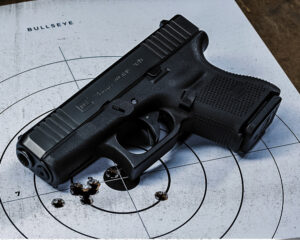
Taurus G2C vs Glock 26: The Ultimate Concealed Carry Showdown
This approach has proven itself through decades of use by law enforcement and military personnel worldwide. Proponents argue that manual safeties represent an additional step that can be forgotten under stress, potentially causing critical delays when seconds matter. They emphasize that proper holster selection and safe handling practices provide adequate safety without requiring manual safety manipulation.
Critics of this approach express concern about the lack of a positive mechanical safety that must be deliberately disengaged. They worry about potential negligent discharges during holstering, particularly for newer shooters who may not yet have developed perfect trigger discipline and muzzle awareness.
Taurus G2C Safety Features
The Taurus G2C takes a more traditional approach to safety, incorporating multiple layers of protection:
- Manual Thumb Safety: A positive mechanical safety lever mounted on the frame that, when engaged, prevents trigger movement and firing. This must be deliberately disengaged before the pistol can fire.
- Trigger Safety: Similar to the Glock’s blade safety, preventing inadvertent trigger movement.
- Firing Pin Block: Mechanically prevents firing pin movement unless the trigger is fully pressed.
- Loaded Chamber Indicator: While not strictly a safety mechanism, this provides visual and tactile confirmation of chamber status, enhancing safety through awareness.
The inclusion of a manual thumb safety appeals to shooters who prefer an additional layer of mechanical protection, particularly during holstering and unholstering. It also appeals to shooters transitioning from platforms like the 1911 or other pistols with manual safeties, as the operation will feel familiar.
However, the manual safety introduces an additional step in the draw-and-fire sequence. Under stress, shooters must remember to disengage the safety after drawing, and failure to do so will prevent the pistol from firing. This concern is somewhat mitigated by training—shooters who practice consistently with their G2C will develop muscle memory for safety manipulation. Additionally, the safety can be left in the “fire” position if the shooter prefers, essentially converting the pistol to a Glock-style passive safety system (though this negates one of the G2C’s distinctive features).
Training and Familiarity Considerations
Regardless of which safety system you prefer, consistent training and practice are essential. Shooters must develop muscle memory for their chosen platform’s operation, ensuring that safety manipulation (or the lack thereof) becomes automatic rather than requiring conscious thought.
At Terry Gun Store, we emphasize that there is no universally “correct” answer to the manual safety debate. Both approaches have proven themselves effective in real-world defensive use. Your choice should be informed by your experience level, training commitment, and personal preferences regarding safety philosophy.
New shooters often appreciate the additional security of a manual safety as they develop their handling skills and trigger discipline. Experienced shooters who train regularly may prefer the simplicity of passive safety systems that eliminate an additional manipulation step. Both approaches are valid when supported by proper training and safe handling practices.
Verdict: Controls and Safety Category
The Taurus G2C offers more control options and safety features, including the manual thumb safety, restrike capability, and loaded chamber indicator. The Glock 26 provides a simpler, more streamlined system with its passive Safe Action safeties and no manual controls beyond the trigger and magazine release.
Your preference in this category will likely be strongly influenced by your background, training, and safety philosophy. Shooters who value simplicity and speed may prefer the Glock’s approach. Those who appreciate additional mechanical safeties and control options may favor the Taurus. Neither approach is objectively superior; both have proven effective in countless defensive situations.
Reliability & Performance in Real-World Conditions
Reliability represents the most critical characteristic of any defensive firearm. A pistol that fails to function when your life depends on it is worse than useless; it provides false confidence while offering no actual protection. Let’s examine how the Glock 26 and Taurus G2C perform in terms of reliability and real-world defensive capability.
Glock 26: Legendary Reliability
The Glock 26’s reliability is legendary within the firearms community, backed by decades of proven performance in the most demanding environments imaginable. Glock pistols have earned their reputation through extensive use by military forces, law enforcement agencies, and civilian carriers worldwide, often functioning flawlessly through tens of thousands of rounds with minimal maintenance.
The Glock design philosophy prioritizes reliability above all else. The pistol features generous tolerances that allow it to function even when dirty, wet, sandy, or otherwise contaminated. The simple design with relatively few parts reduces potential failure points, and the robust construction ensures components withstand the stresses of repeated firing.
Glock pistols are renowned for their ability to function with a wide variety of ammunition types, from budget practice rounds to premium defensive ammunition. This ammunition tolerance means you can train with affordable practice ammunition while carrying premium defensive loads, confident that both will function reliably.
The Glock 26 specifically has proven itself as a reliable concealed carry option for countless users. While its compact size and light weight do result in more pronounced recoil compared to larger pistols, the fundamental reliability of the Glock design remains intact in this smaller package.
Taurus G2C: Exceeding Expectations
The Taurus G2C has developed a strong reputation for reliability that has surprised many shooters who harbored preconceptions about Taurus firearms based on the company’s earlier products. The G2C represents a significant evolution in Taurus’s manufacturing quality and design execution, and user reports consistently praise its reliability.
Numerous shooters have reported firing thousands of rounds through their G2C pistols without experiencing malfunctions, and the pistol has proven capable of digesting various ammunition types without issues. While the G2C may not have the decades-long track record of the Glock 26, its performance in the years since its introduction has been impressive.
The G2C’s reliability is particularly noteworthy given its price point. Many shooters expect budget-priced firearms to compromise reliability for affordability, but the G2C has largely defied this expectation. This doesn’t mean every individual G2C will be flawless, as with any manufactured product, occasional examples may have issues, but the overall reliability track record is strong.
Accuracy and Practical Precision
Both pistols deliver adequate accuracy for defensive purposes. It’s important to understand that defensive pistol accuracy requirements differ significantly from target shooting or competition. In defensive scenarios, you’re typically engaging threats at close distances (often within 7 yards), under extreme stress, and with limited time. In these circumstances, combat accuracy, the ability to place rapid shots in the vital zones of a human-sized target, matters far more than precision target accuracy.
Both the Glock 26 and Taurus G2C are capable of greater mechanical accuracy than most shooters can achieve under stress. The limiting factor in defensive accuracy is typically the shooter’s skill, stress management, and training rather than the pistol’s inherent precision.
That said, both pistols are capable of respectable accuracy when fired from a rest or by skilled shooters. Groups of 2-3 inches at 25 yards are achievable with either platform, which far exceeds the accuracy requirements for defensive use.
Recoil Management and Controllability
Both pistols, being compact 9mm handguns, generate noticeable recoil. The laws of physics dictate that lighter, smaller pistols will produce more felt recoil than heavier, larger pistols firing the same ammunition. However, both the Glock 26 and Taurus G2C manage recoil adequately for their size and weight class.
The Glock 26’s grip angle and ergonomics help direct recoil straight back into the shooter’s hand, facilitating rapid recovery between shots. The aggressive grip texturing provides secure purchase even during rapid-fire strings.
The Taurus G2C’s slightly heavier weight (by less than half an ounce) provides negligibly more mass to absorb recoil, though the difference is imperceptible in practical shooting. The aggressive grip texture similarly ensures positive control during recoil.
Shooters with smaller hands or less upper body strength may find the recoil of these compact pistols somewhat challenging initially, though proper grip technique and regular practice typically resolve this concern. Both pistols are controllable for most adult shooters, though they’re not as soft-shooting as larger, heavier pistols.
Durability and Service Life
The Glock 26’s durability is well-established, with many examples remaining in service through tens of thousands of rounds. The steel slide and robust polymer frame ensure longevity even with regular use and carry. Glock pistols are designed for a service life of approximately 100,000+ rounds, though many examples exceed this significantly.
The Taurus G2C’s long-term durability is less established simply due to its shorter time in the market, but early indications suggest it will provide adequate service life for typical civilian use. Most civilian carriers fire relatively few rounds through their defensive pistols—perhaps a few hundred rounds per year for practice and qualification. At this usage rate, the G2C should provide decades of reliable service.
The aluminum alloy slide on the G2C may show wear more quickly than the Glock’s Tenifer-treated steel slide, particularly at high round counts, but this is unlikely to affect function for most users.
Verdict: Reliability and Performance Category
The Glock 26 holds an advantage in this category due to its longer track record and proven reliability across decades of use in demanding conditions. However, the Taurus G2C has performed admirably in the years since its introduction, and most users report excellent reliability. For typical civilian defensive use, both pistols should provide adequate reliability and performance.
The Glock’s longer history and more extensive real-world testing provide greater confidence for some users, while the G2C’s strong performance at a lower price point appeals to others. At Terry Gun Store, we’ve seen both pistols perform reliably for our customers, and we’re confident recommending either for defensive use.
Maintenance & Aftermarket Support
The ease of maintenance and availability of aftermarket parts and accessories significantly impact the long-term ownership experience. Let’s examine how these pistols compare in terms of maintenance requirements and aftermarket support.
Maintenance Requirements and Field Stripping
Both the Glock 26 and Taurus G2C are designed for easy field stripping and basic maintenance, requiring no special tools for routine cleaning and lubrication.
Glock 26 Maintenance
The Glock 26 field strips in seconds using Glock’s simple takedown procedure:
- Remove the magazine and verify the chamber is empty
- Pull the slide back slightly and pull down on the takedown tabs
- Release the slide and pull the trigger while easing the slide forward off the frame
- Remove the recoil spring assembly and barrel
This process requires no tools and can be performed in the field if necessary. Reassembly is equally straightforward, simply reversing the process.
Glock recommends cleaning and lubrication after each use, though the pistols are famously tolerant of neglect and will often function reliably even when dirty. Basic maintenance involves cleaning the barrel, slide rails, and other contact surfaces, then applying a light coat of quality gun oil to moving parts.
Glock pistols require minimal maintenance beyond regular cleaning and lubrication. The recoil spring should be replaced every 5,000-10,000 rounds, depending on use, and other springs may eventually require replacement, but these are inexpensive and readily available.
Taurus G2C Maintenance
The Taurus G2C similarly field strips easily:
- Remove the magazine and verify the chamber is empty
- Rotate the takedown lever
- Pull the slide back slightly and lift it off the frame
- Remove the recoil spring assembly and barrel
Like the Glock, this requires no tools and can be accomplished quickly. Reassembly is straightforward.
Maintenance requirements are similar to the Glock, regular cleaning and lubrication after use, with periodic replacement of springs as they wear. The G2C is designed for easy maintenance by the end user.
Aftermarket Support and Customization
This category represents one of the most significant differences between these platforms.
Glock 26 Aftermarket Support
The Glock 26 benefits from the most extensive aftermarket support of virtually any pistol platform. Decades of market presence and enormous popularity have resulted in countless manufacturers producing Glock-compatible parts and accessories. This includes:
- Triggers: Numerous aftermarket trigger options offering different pull weights, break characteristics, and reset distances
- Sights: Extensive selection from every major sight manufacturer
- Barrels: Aftermarket barrels offering different finishes, threading for suppressors, or enhanced accuracy
- Slides: Complete aftermarket slides with custom cuts, optics mounting, and various finishes
- Internal Parts: Every internal component is available from multiple manufacturers
- Magazines: Extensive selection of factory and aftermarket magazines in various capacities
- Holsters: Thousands of holster options from hundreds of manufacturers
- Accessories: Magazine extensions, grip plugs, slide covers, and countless other accessories
This extensive aftermarket support means you can customize your Glock 26 to an extraordinary degree, tailoring it precisely to your preferences and requirements. It also means that replacement parts are readily available if anything breaks or wears out.
Taurus G2C Aftermarket Support
The Taurus G2C’s aftermarket support is growing, but remains more limited compared to Glock. As the pistol’s popularity has increased, more manufacturers have begun producing compatible accessories, but the selection doesn’t approach what’s available for Glock pistols.
Available aftermarket items include:
- Sights: Night sights and other upgrades from select manufacturers
- Magazines: Factory and some aftermarket magazine options
- Holsters: Growing selection from major holster manufacturers
- Accessories: Magazine extensions and some other accessories
The more limited aftermarket support isn’t necessarily a significant disadvantage for most users. The G2C is a functional defensive pistol in its factory configuration, and many shooters never feel compelled to modify or customize their defensive firearms beyond perhaps upgrading to night sights.
However, shooters who enjoy customization or who want the security of knowing replacement parts are readily available may find the Glock’s extensive aftermarket support appealing.
Parts Availability and Replacement
Glock parts are available from countless sources, including Glock directly, numerous online retailers, and local gun shops. If a part breaks or wears out, replacement is typically quick and inexpensive.
Taurus G2C parts are available from Taurus and select retailers, though the selection and availability don’t quite match Glock. That said, the G2C’s reliability means most users will never need replacement parts beyond routine maintenance items like springs.
Both manufacturers offer warranty support for their pistols, though Glock’s warranty is lifetime, while Taurus offers a limited lifetime warranty with some conditions.
Verdict: Maintenance and Aftermarket Support Category
The Glock 26 holds a clear advantage in this category due to its extensive aftermarket support and parts availability. However, for shooters who don’t plan extensive customization and simply want a reliable defensive pistol that’s easy to maintain, the Taurus G2C’s more limited aftermarket support may not represent a significant disadvantage.
At Terry Gun Store, we stock parts and accessories for both platforms and can help you find whatever you need to maintain and customize your pistol.
Price-to-Value Ratio Analysis
The relationship between price and value represents a critical consideration for most firearms purchasers. Let’s examine what you receive for your investment with each of these pistols.
Initial Purchase Price
The most obvious difference between these pistols is their MSRP:
- Glock 26: Approximately $600 MSRP
- Taurus G2C: Approximately $304 MSRP
Street prices typically run somewhat lower than MSRP, with the Glock 26 often available for $500-550 and the Taurus G2C for $250-280. However, the proportional difference remains substantial—the Taurus costs roughly half what the Glock does.
This price difference of $250-300 represents significant money that could be invested elsewhere in your defensive system.
What You Get for Your Money
Glock 26 Value Proposition
For approximately $600, the Glock 26 provides:
- Legendary reliability backed by decades of proven performance
- Extensive aftermarket support for customization and parts replacement
- Modular grip system for customized fit
- Compatibility with higher-capacity Glock 17 and 19 magazines
- Tenifer-treated steel slide for maximum durability
- Lifetime warranty
- Strong resale value
- The confidence that comes with carrying a proven platform
The Glock 26 represents a premium product commanding a premium price. You’re paying for Glock’s chamberedreputation, proven track record, and the peace of mind that comes with carrying a pistol trusted by military and law enforcement worldwide.
Taurus G2C Value Proposition
For approximately $300, the Taurus G2C provides:
- Reliable performance that has exceeded many shooters’ expectations
- Higher standard capacity (12+1 vs 10+1)
- Integrated accessory rail for lights or lasers
- Manual thumb safety for additional security
- Restrike trigger capability
- Loaded chamber indicator
- Limited lifetime warranty
- Exceptional value for the price
The Taurus G2C represents remarkable value, delivering features and reliability that would typically command a higher price. The money saved compared to the Glock can be invested in training, ammunition, or accessories.
Total Cost of Ownership
When evaluating value, consider the total cost of ownership beyond the initial purchase price:
Ammunition for Training: Both pistols are chamber 9mm, so ammunition costs are identical. However, the $250-300 saved by choosing the Taurus could purchase 1,000+ rounds of practice ammunition, enough for significant skill development.
Holsters: Quality holsters for both platforms cost approximately the same, typically $50-100 for a good Kydex or leather holster.
Sights: Aftermarket night sights cost approximately the same for both platforms, typically $80-150 installed.
Magazines: Glock magazines are somewhat more expensive than Taurus magazines, though both are reasonably priced. However, the Glock’s compatibility with higher-capacity G17 and G19 magazines provides flexibility.
Maintenance: Both pistols have similar maintenance requirements and costs.
Resale Value Considerations
Glock pistols typically retain their value exceptionally well. A well-maintained used Glock 26 might sell for 70-80% of its original purchase price, even after years of use. This strong resale value means your investment is somewhat protected.
Taurus pistols historically have not retained value as well as Glocks, though the G2C’s strong reputation may improve this somewhat. A used G2C might sell for 50-60% of its original purchase price.
If you view your defensive pistol as an investment that you might eventually sell or trade, the Glock’s stronger resale value represents an advantage. However, many defensive pistol owners never sell their carry guns, making resale value irrelevant.
The Training Investment Argument
At Terry Gun Store, we emphasize that the firearm itself represents just one component of an effective defensive system. Training and skill development contribute as much or more to defensive preparedness as the specific pistol you carry.
The $250-300 saved by choosing the Taurus G2C could fund:
- A comprehensive defensive pistol course from a qualified instructor ($200-400)
- 1,000+ rounds of practice ammunition ($300-400 worth)
- Multiple training sessions at a local range
- Professional coaching or private instruction
This training investment will improve your defensive capability far more than the marginal differences between these two pistols. A skilled shooter with a Taurus G2C is far more capable than an untrained shooter with a Glock 26.
Verdict: Price-to-Value Category
The Taurus G2C offers exceptional value, delivering reliable performance and useful features at roughly half the cost of the Glock 26. For budget-conscious buyers or those who want to invest more in training and less in the firearm itself, the G2C represents an outstanding choice.
The Glock 26 commands a premium price but delivers premium features, proven reliability, and extensive aftermarket support. For shooters who can afford the higher initial investment and value the peace of mind that comes with Glock’s reputation, the G26 justifies its cost.
Neither pistol is overpriced for what it delivers. The Glock 26 is worth its premium price for those who value its advantages, while the Taurus G2C represents remarkable value for those prioritizing affordability.
Making Your Final Decision: Which Pistol Suits Your Needs?
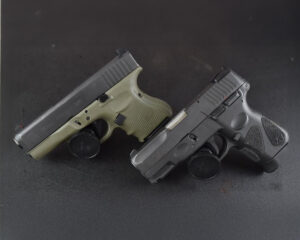
![Both the Taurus G2C and the Glock 26 side by side.]
After examining every aspect of these two excellent concealed carry pistols, the time has come to synthesize this information and determine which platform best serves your specific needs and circumstances.
Key Decision Factors
Choose the Glock 26 if:
- You prioritize proven reliability backed by decades of real-world performance
- You value extensive aftermarket support for customization and parts availability
- You already own other Glock pistols and want magazine compatibility
- You prefer passive safety systems without manual safeties
- You want modular backstraps for a customized grip fit
- You’re willing to invest more initially for a premium product
- You value strong resale value
- You prefer the simplicity of Glock’s Safe Action trigger system
- You want the option of an optics-ready MOS variant
Choose the Taurus G2C if:
- Budget is a primary concern, and you want to invest savings in training and ammunition
- You wanta higher standard capacity (12+1 vs 10+1)
- You value an integrated accessory rail for lights or lasers
- You prefer having a manual thumb safety
- You appreciate the restrike trigger capability
- You want a loaded chamber indicator for enhanced safety awareness
- You’re a newer shooter who appreciates additional safety features
- You want excellent value and are willing to accept more limited aftermarket support
The Training and Practice Consideration
Regardless of which pistol you choose, commit to regular training and practice. The most expensive, reliable pistol in the world provides no defensive capability if you can’t shoot it accurately under stress. Conversely, a budget-friendly pistol in the hands of a trained, practiced shooter provides excellent defensive capability.
At Terry Gun Store, we encourage all our customers to invest significantly in training, whether through professional instruction, regular range practice, or both. The skills you develop through training will serve you far better than any specific firearm feature or specification.
The Holster and Support Gear Factor
Whichever pistol you choose, invest in a quality holster and gun belt. A proper holster provides secure retention, protects the trigger, and allows for a consistent, efficient draw stroke. A quality gun belt supports the weight of your pistol and holster without sagging or shifting.
We stock comprehensive selections of holsters for both the Glock 26 and Taurus G2C at Terry Gun Store, including:
- IWB (Inside-the-Waistband) Holsters: For maximum concealment
- OWB (Outside-the-Waistband) Holsters: For open carry or range use
- Pocket Holsters: For pocket carry in appropriate clothing
- Appendix Carry Holsters: For front-of-body carry
- Hybrid Holsters: Combining Kydex and leather for comfort and retention
Our knowledgeable staff can help you select the optimal holster configuration for your chosen pistol, body type, wardrobe, and carry preferences.
The “Try Before You Buy” Recommendation
If possible, try to shoot both pistols before making your final decision. Many ranges offer rental firearms, allowing you to experience each pistol’s handling characteristics, trigger feel, and recoil management firsthand. What feels perfect for one shooter may feel awkward for another, and there’s no substitute for actual shooting experience when making this decision.
At Terry Gun Store, we can connect you with local ranges that offer rental firearms and may be able to arrange demonstration opportunities for serious buyers.
Taurus G2C vs Glock 26: The Ultimate Concealed Carry Showdown
The Bottom Line
Both the Glock 26 and Taurus G2C are excellent concealed carry pistols that will serve you well in defensive situations. The Glock 26 represents a premium option with proven reliability, extensive support, and features that justify its higher price. The Taurus G2C delivers remarkable value, offering reliable performance and useful features at an accessible price point.
Your decision should be informed by your budget, experience level, feature preferences, and intended use. There is no universally “correct” choice, only the choice that’s correct for your specific circumstances and requirements.
Visit Terry Gun Store for Expert Guidance
At Terry Gun Store, we’re committed to helping you make informed decisions about your defensive firearms. Our knowledgeable staff has extensive experience with both the Glock 26 and Taurus G2C, and we can provide personalized guidance based on your specific needs and circumstances.
We invite you to visit our showroom to handle both pistols, discuss their features and differences, and explore our extensive selection of holsters and accessories. We can also connect you with training resources and help you build a complete defensive system that extends beyond just the firearm itself.
Additional Resources from Terry Gun Store
To further support your concealed carry journey, we encourage you to explore these additional resources:
Holsters by Gun Model: Visit our comprehensive holster selection page, where you can filter options specifically for the Glock 26 or Taurus G2C. We stock holsters from leading manufacturers in various carry positions and materials, ensuring you’ll find the perfect match for your pistol and carry preferences.
Interactive Comparison Tool: Not sure which holster style is right for you? Our interactive comparison tool allows you to view holsters side-by-side, compare features, and filter by specific characteristics like retention type, material, and carry position. This tool helps you make informed decisions about your carry system.
Resources Page: Explore our extensive resources section featuring gear recommendations, concealed carry guides, legal information, training tips, and exclusive content designed to elevate your defensive preparedness. We regularly update this section with new articles, videos, and guides to support your ongoing education and skill development.
Expert Consultation: Schedule a consultation with our firearms experts to discuss your specific needs, try different holster configurations, and receive personalized recommendations based on your body type, wardrobe, and lifestyle.
Conclusion
The choice between the Taurus G2C and Glock 26 ultimately comes down to your individual priorities, budget, and preferences. Both pistols have earned their places in the concealed carry market through reliable performance and practical features. The Glock 26 offers premium quality, proven reliability, and extensive support at a premium price. The Taurus G2C delivers exceptional value, useful features, and reliable performance at an accessible price point.
Whichever pistol you choose, commit to regular training, invest in quality support gear, and practice consistently. These factors will contribute far more to your defensive capability than the specific pistol you carry.
At Terry Gun Store, we’re here to support you throughout your concealed carry journey, from initial pistol selection through holster fitting, training resources, and ongoing support. Visit us today to experience the difference that knowledgeable, personalized service makes in your firearms purchasing experience.
Your safety and preparedness are our priorities. Let us help you build a defensive system that provides confidence, capability, and peace of mind.