
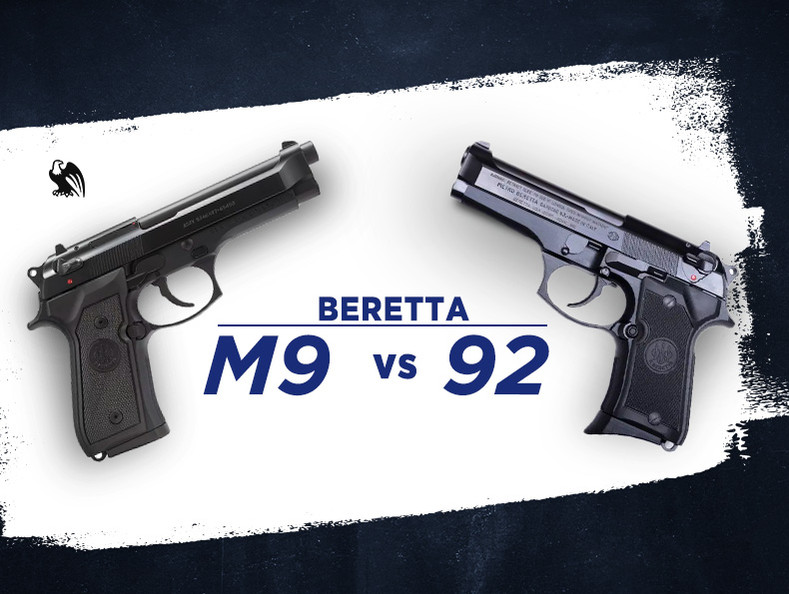
Beretta M9 vs 92: Identical Firearms with Different Designations?
In This Article
- Understanding the Beretta M9
- Exploring the Beretta 92
- Technical Specifications: Beretta M9 vs 92 Comparison
- Beretta 92 vs M9: Dimensions & Magazine Capacity
- Beretta M9 vs 92: Ergonomic Design Features
- Beretta 92 vs M9: Sight Systems & Optics Compatibility
- Beretta M9 vs 92: Operating Controls & Safety Features
- History & Development of Both Models
- Performance & Reliability Comparison
- Beretta M9 vs 92: Which Should You Choose?
Introduction: Understanding the Nomenclature
Occasionally, in the firearms industry, model designations, numerical codes, and military nomenclature create confusion when distinguishing between what are essentially identical weapons platforms.
When examining the Beretta M9 versus the 92, this represents a textbook example of such a scenario – these are fundamentally the same handgun, merely bearing different designations. The variation in nomenclature stems exclusively from the intended end-user designation of each variant.
While the M9 carries a military designation for armed forces deployment and the 92 targets civilian shooters and law enforcement agencies, these firearms are essentially identical weapons featuring only negligible variations. Both deliver equivalent performance regarding accuracy, reliability, and operational longevity.
Ultimately, your selection between these two legendary pistols will predominantly depend on market availability and personal preference, though being thoroughly informed never disadvantages any firearm enthusiast. This comprehensive guide from Terry Gun Store will examine the developmental history, mechanical composition, and subtle distinctions between these two celebrated “wonder nine” handguns that revolutionized modern pistol design.
Understanding the Beretta M9
Military Heritage and Adoption
Functionally equivalent to the civilian 92FS model, the Beretta M9 secured the prestigious United States military contract to supersede the venerable Browning M1911 after NATO leadership determined to standardize ammunition specifications across member nations for enhanced logistical efficiency, according to documentation from the Marine Corps Association.
Beretta M9 vs 92: Identical Firearms with Different Designations?
Evolving from the developmental lineage of the Beretta M1922 and M1951 pistols, this handgun incorporates the distinctive open-slide configuration characteristic of its predecessors. Chambered in the NATO-standard 9x19mm Parabellum cartridge, the M9 ships standard with a 15-round detachable box magazine and exemplifies precisely why NATO leadership selected that cartridge specification over the larger .45 ACP round. Compact variants accommodate 10 rounds, while aftermarket extended magazines available through retailers like Terry Gun Store can hold up to 20 rounds.
Construction and Durability
An aluminum alloy frame complemented by polymer grip panels renders the M9 an absolute workhorse capable of functioning reliably across all environmental conditions, and this pistol has literally seen deployment across every continent since its introduction during the 1980s.
Straightforward to operate and exceptionally reliable, this firearm represents an outstanding addition to any firearms collection, whether for professional duty use, competitive shooting, or personal defense applications.
If you’re searching for a premium Beretta M9 holster, Terry Gun Store offers an extensive selection of inside-the-waistband (IWB), outside-the-waistband (OWB), and pocket carry configurations to customize one perfectly suited for your specific carry methodology.
Exploring the Beretta 92
Revolutionary Impact on Law Enforcement
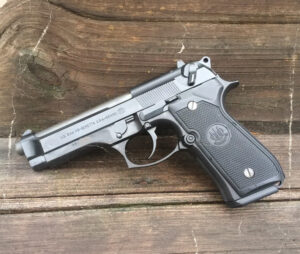
![Beretta 92 handgun photography laying against wood.]
Throughout the period preceding the 1980s, revolvers maintained dominance as the predominant handgun type employed by law enforcement agencies nationwide. When the Beretta 92 entered the commercial marketplace, it fundamentally transformed the landscape.
The inaugural model of what would evolve into one of the most celebrated pistol series in firearms history, the 92 was engineered to become the most dependable and accurate semi-automatic handgun of its generation. This firearm incorporates the identical open-slide design, aluminum alloy frame construction, and polymer grip panels that characterize the M9. Featuring sophisticated safety mechanisms, this weapon became the premier handgun for those preferring concealed carry applications.
Design Philosophy and Capacity
This double-action/single-action pistol ships standard with a magazine accommodating 15 rounds of 9mm ammunition, rendering it exceptional for engaging multiple targets without encountering limited capacity constraints that plague smaller-capacity firearms.
Numerous variations and evolutionary improvements have been introduced to the platform since this foundational model reached consumers, but they all build upon the identical core features that established this firearm’s legendary reputation.
At Terry Gun Store, we recognize the enduring appeal of this classic design and maintain a comprehensive inventory to serve both collectors and practical shooters.
Technical Specifications: Beretta M9 vs 92 Comparison
| Specification | Beretta M9 | Beretta 92 |
|---|---|---|
| Caliber | 9x19mm Parabellum | 9x19mm Parabellum |
| Size Classification | Full-Size Service Pistol | Full-Size Service Pistol |
| Overall Height | 5.4 inches | 5.4 inches |
| Overall Length | 8.5 inches | 8.5 inches |
| Barrel Length | 4.9 inches | 4.9 inches |
| Overall Width | 1.5 inches | 1.5 inches |
| Unloaded Weight | 33.3 ounces | 33.3 ounces |
| Standard Capacity | 15 rounds | 15 rounds |
| Manufacturer’s Suggested Retail Price | $799 | $700 |
Beretta 92 vs M9: Dimensions & Magazine Capacity
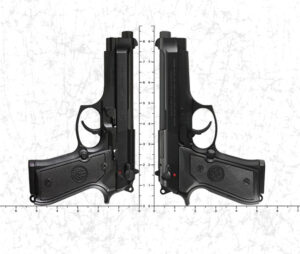
Beretta 92 vs M9: Size side-by-side comparison
As the specifications table clearly demonstrates, the distinction between the Beretta M9 versus 92 has absolutely nothing to do with physical dimensions or ammunition capacity.
Beretta M9 vs 92: Identical Firearms with Different Designations?
Identical Physical Dimensions
These two firearms both measure precisely 5.4 inches in height, 8.5 inches in overall length, and 1.5 inches in width, featuring an identical 4.9-inch barrel length. Additionally, both the Beretta 92 and Beretta M9 weigh exactly 33.3 ounces when unloaded.
Capacity Advantages of 9mm
NATO’s strategic decision to standardize around the 9x19mm cartridge was predicated on the opportunity for substantially higher ammunition capacity with minimal reduction in terminal ballistic performance and stopping power. These pistols both accommodate standard 15-round magazines compared to the typical 7-10 round magazines common to many .45 ACP pistols of the same era.
Compact 10-round versions are available for jurisdictions with capacity restrictions, and extended-capacity magazines offering 17, 18, or even 20-round capacity can be sourced through specialty retailers like Terry Gun Store.
Practical Implications
This generous capacity provides significant tactical advantages for defensive scenarios, competitive shooting disciplines, and extended training sessions without frequent magazine changes. The 9mm chambering also offers reduced recoil compared to larger calibers, facilitating faster follow-up shots and enhanced accuracy for shooters of varying experience levels.
Beretta M9 vs 92: Ergonomic Design Features
Frame Construction and Grip Design
The frame construction of both the M9 and 92 utilizes lightweight yet durable aluminum alloy, featuring a 1.4-inch width polymer grip panel system. This configuration proves particularly advantageous for shooters with larger hand dimensions who often struggle with compact pistol ergonomics.
While numerous aftermarket products exist for customization and personalization, these handguns were intentionally engineered with interchangeable components facilitating effortless disassembly, incorporating features like their tool-free field-stripping latch mechanism that requires no additional implements for routine maintenance.
Terry Gun Store stocks various aftermarket grip options, allowing you to customize the feel and texture to match your specific preferences and hand size.
Slide & Barrel Engineering
The Bruniton-coated open-top slide design represents a signature feature across most of Beretta’s handgun lineup, so its presence on both the M9 and 92 should surprise no one familiar with the manufacturer’s design philosophy. An enlarged hammer retention pin prevents the slide assembly from separating from the rear of both firearms during operation.
Beretta M9 vs 92: Identical Firearms with Different Designations?
This slide and barrel engineering allows for a substantial reduction in feeding malfunctions and jamming incidents while simultaneously providing exceptional resistance to environmental exposure, moisture intrusion, and corrosion damage.
The open-slide configuration also facilitates superior debris ejection, making these pistols particularly reliable in adverse conditions, including sand, mud, and extreme temperature environments – a critical consideration that influenced military adoption.
Grip Angle and Pointing Characteristics
Both models feature a natural grip angle that promotes instinctive pointing for most shooters. The grip-to-bore axis height is optimized to manage recoil effectively while maintaining controllability during rapid-fire sequences. The textured grip panels provide secure purchase without being overly aggressive, making these pistols comfortable for extended shooting sessions.
Beretta 92 vs M9: Sight Systems & Optics Compatibility
Traditional Iron Sight Configuration
During the 1980s era, when these designs were finalized, firearms manufacturers had not yet embraced the cutting-edge sight systems and miniaturized optics that dominate today’s market.
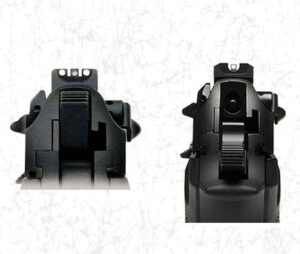
Sight systems represent minimal differentiation in the Beretta M9 versus 92 comparison. Both pistols feature a standard three-dot iron sight configuration utilizing a dot-and-bar system. While both firearms provide a 6.1-inch sight radius for enhanced accuracy potential, the M9 does incorporate a squared-off rear sight profile compared to the slightly rounded configuration of the standard 92.
Optics Mounting Considerations
Regarding modern miniaturized red-dot optics mounting, neither the standard Beretta M9 nor the 92 arrives optics-ready directly from the factory.
If you’re specifically seeking to mount a miniaturized red-dot sight on your pistol without modification, these traditional models definitely aren’t optimal choices in their factory configuration. However, the proven and time-tested three-dot iron sight system remains highly effective for rapid target acquisition across various lighting conditions and distances.
Alternatively, more recent variations within the Beretta 9-series family, including the 92X series and M9A3 variant, are available with factory optics-ready slide cuts. Terry Gun Store can provide guidance on these modern variants if optics compatibility represents a priority for your intended application.
Aftermarket Modifications
For enthusiasts determined to add optics to standard M9 or 92 models, aftermarket slide milling services can add mounting plates for popular optics footprints, though this requires professional gunsmithing and may affect the firearm’s collectible value.
Beretta M9 vs 92: Operating Controls & Safety Features
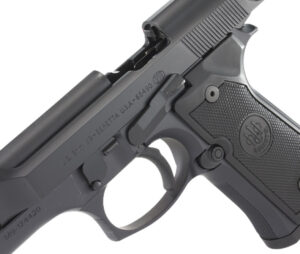
![Close-up of a Beretta M9 9mm semi-automatic pistol showing the slide, safety lever, trigger guard, and grip texture, with clear engraving of model and serial number, ideal for firearm comparison guides, military sidearm discussions, or gun safety education.]
Comprehensive Safety Mechanisms
Safety mechanisms represent essential components of every defensive firearm, particularly for those planning concealed carry applications. Once again, absolutely no functional difference exists between the M9 and 92 regarding these critical features.
Reversible magazine release buttons and ambidextrous safety-decocker levers come standard on both firearms, accommodating both right-handed and left-handed shooters without modification. Additionally, automatic firing pin block safeties prevent the hammer from contacting the firing pin in scenarios where the weapon is accidentally dropped or subjected to impact.
The combination safety-decocker lever allows shooters to safely lower the hammer on a chambered round, transitioning the pistol to double-action mode for the first shot. This provides an additional margin of safety while maintaining the firearm in a ready condition.
Trigger System Characteristics
The singular mechanical difference between these two firearms involves the M9 featuring a straighter trigger guard profile compared to the predominantly curved configuration of the standard 92 – a modification implemented to accommodate military glove use.
Both firearms feature rear grip undercuts that substantially reduce trigger reach distance, benefiting shooters with smaller hands. While resting in double-action mode with the hammer down, both the M9 and 92 exhibit a trigger pull weight of approximately 12 pounds for the first shot, transitioning to approximately 4.5-5.5 pounds for subsequent single-action shots.
This DA/SA (double-action/single-action) trigger system provides the safety of a heavier first trigger pull while offering the precision of a lighter trigger for follow-up shots. Many shooters appreciate this traditional operating system, though it does require dedicated training to master the transition between trigger modes.
Beretta M9 vs 92: Identical Firearms with Different Designations?
Magazine Release and Slide Stop
Both models feature easily accessible magazine release buttons positioned for thumb operation by right-handed shooters, with reversibility for left-handed users. The slide stop lever is similarly positioned for intuitive operation, allowing shooters to lock the slide open for inspection or release it to chamber a round.
History & Development of Both Models
Origins and Evolution
The Beretta 92 series traces its lineage to earlier Beretta designs, incorporating lessons learned from decades of military and police service worldwide. The original Beretta 92 was introduced in 1975, featuring the distinctive open-slide design that would become synonymous with the platform.
Throughout the late 1970s, Beretta continuously refined the design, addressing feedback from military and law enforcement testing. The 92S introduced the magazine-mounted safety, while the 92SB added the ambidextrous safety-decocker and firing pin block that would become standard features.
Military Adoption Process
The M9 designation emerged from the U.S. military’s Joint Service Small Arms Program (JSSAP) trials conducted during the 1980s. After extensive testing against competitors, including the SIG Sauer P226, Smith & Wesson, and others, the Beretta 92F (which became the M9) was selected in 1985.
This selection proved controversial initially, with some preferring the .45 ACP cartridge of the M1911. However, the M9’s higher capacity, reduced recoil, and NATO standardization advantages ultimately prevailed. The pistol entered service in 1990 and served as the standard U.S. military sidearm for nearly three decades.
Continuous Improvement
Both the civilian 92 series and military M9 have undergone continuous refinement. Improvements have included enhanced grip texturing, upgraded sights, accessory rails for tactical lights, and various finish options. The M9A1 added a Picatinny rail and improved grip checkering, while the M9A3 introduced earth-tone finishes and enhanced features.
Terry Gun Store maintains expertise in the complete evolutionary history of these platforms and can guide collectors and shooters toward specific variants matching their requirements.
Performance & Reliability Comparison
Accuracy and Precision
Both the M9 and 92 deliver exceptional accuracy for service pistols in their class. The 4.9-inch barrel length, combined with the locked-breech short-recoil operating system, provides excellent mechanical accuracy. Experienced shooters can consistently achieve 2-3 inch groups at 25 yards from a supported position.
The relatively long sight radius of 6.1 inches contributes to precise shot placement, particularly when compared to more compact pistols with abbreviated sight planes. The single-action trigger pull, once the hammer is cocked, offers sufficient crispness for accurate shooting in defensive and competitive contexts.
Reliability and Durability
Both models have established legendary reputations for reliability across diverse environmental conditions. Military testing subjected the M9 to extreme temperature ranges, sand and dust exposure, water immersion, and drop tests – all of which it passed with exceptional performance.
The open-slide design, while initially questioned by some traditionalists, actually enhances reliability by allowing debris to escape rather than accumulating within the action. This design choice has proven particularly valuable in desert and maritime environments.
Expected service life for these pistols exceeds 30,000 rounds with proper maintenance, with many examples documented well beyond 50,000 rounds while maintaining acceptable accuracy and function. The aluminum frame does eventually experience wear at high round counts, but replacement frames are available for pistols requiring refurbishment.
Ammunition Compatibility
Both the M9 and 92 function reliably with virtually all factory 9mm ammunition, from standard 115-grain ball ammunition to +P defensive loads and subsonic ammunition. This versatility makes them excellent choices for shooters who want a single platform capable of handling training ammunition, defensive loads, and specialized applications.
Terry Gun Store recommends testing your specific pistol with your chosen defensive ammunition to verify reliable function and point of impact, as individual firearms may exhibit preferences for certain loads.
Beretta M9 vs 92: Which Should You Choose?
Practical Considerations
As this comprehensive analysis demonstrates, virtually no meaningful differences exist between the Beretta M9 versus 92 that would make one objectively superior to the other or more suitable for specific shooter demographics.
It remains factual that the Beretta M9 represents the military-designated nomenclature for their version of the 92 platform. The only compelling reason to specifically pursue one over the other would be if you specifically collect military-issued firearms or desire the cachet of owning the exact military designation. Otherwise, both are functionally equivalent regarding accuracy, durability, and operational performance when deployed for their intended purposes, which ultimately represents the most critical consideration when evaluating any firearm purchase.
Availability and Market Considerations
That stated, since the 92 enjoys broader availability to civilian purchasers, these models are substantially easier to locate through retailers like Terry Gun Store and offer more extensive customization options through aftermarket support. The civilian market has produced countless accessories, replacement parts, and upgrade components specifically for the 92 series.
Military surplus M9 pistols occasionally appear on the civilian market, often at attractive prices, though these will typically show service wear. For shooters prioritizing condition and warranty coverage, new-production 92 models represent the more practical choice.
Modern Variants and Alternatives
If you’re seeking something specific within the M9/92 family with enhanced features, numerous options now exist on the market with varying degrees of deviation from the original design, including the 92FS (the current civilian equivalent to the M9), 92 LTT (Langdon Tactical Technology collaboration), 92X series (with improved ergonomics and optics compatibility), and the latest 92XI (competition-oriented variant).
The M9A3 represents the most modern military variant, incorporating a threaded barrel, Picatinny accessory rail, enhanced sights, and earth-tone finish options. For shooters desiring the M9 designation with contemporary features, this variant offers the best of both worlds.
Final Recommendation from Terry Gun Store
The Beretta M9 and 92 are both distinguished 9mm service pistols with proven track records from their deployment around the world across multiple decades. We encourage you to visit Terry Gun Store to handle both variants and determine which feels most natural in your hands.
For most practical shooters, the decision will ultimately come down to which specific example offers the best value, condition, and availability at the time of purchase. Both will serve you exceptionally well for defensive carry, home protection, competitive shooting, or recreational range use.
If you’re searching for a premium holster for one of these legendary pistols, Terry Gun Store offers custom Kydex holsters in IWB, OWB, and pocket carry configurations, precisely molded for your specific weapon to ensure perfect retention and smooth presentation.
Beyond Holsters: Complete Shooting Solutions
Interested in products beyond holsters? Terry Gun Store maintains a comprehensive resources section featuring links to recommended products, including weapon-mounted lights, laser aiming devices, first aid supplies, maintenance equipment, and much more. Browse our selection of tactical apparel, reinforced gun belts, and shooting accessories to complete your setup.
For those seeking minimalist everyday carry solutions, explore our sister company, GeoGrit, to view our collection of durable, RFID-blocking minimalist wallets that complement your concealed carry lifestyle.
Conclusion: Two Names, One Legendary Platform
The Beretta M9 versus 92 comparison ultimately reveals what experienced shooters already understand – these are essentially identical firearms bearing different designations based on their intended market. Whether you choose the military-designated M9 or the civilian 92, you’re acquiring a piece of firearms history that has proven itself across decades of service in the most demanding conditions imaginable.
Both models represent the pinnacle of 1980s service pistol design, and while newer designs have introduced incremental improvements, the fundamental excellence of this platform remains undeniable. The combination of reliability, accuracy, capacity, and ergonomics continues to make these pistols relevant choices for modern shooters.
Terry Gun Store stands ready to assist you in selecting the perfect variant for your specific needs, whether you’re a collector seeking a specific military contract example, a competitive shooter requiring a proven platform, or a defensive carrier wanting a reliable sidearm with decades of proven performance.
Visit Terry Gun Store today to explore our inventory of Beretta M9 and 92 variants, along with the complete ecosystem of accessories, ammunition, and support equipment to maximize your shooting experience. Our knowledgeable staff can answer any questions and help you make an informed decision that you’ll be satisfied with for years to come.
The legacy of the Beretta 92/M9 platform continues to evolve, but the core excellence that made these pistols legendary remains unchanged. Whether you’re drawn to the military heritage of the M9 or the civilian versatility of the 92, you’re choosing a firearm that has earned its place in history through performance, not marketing.